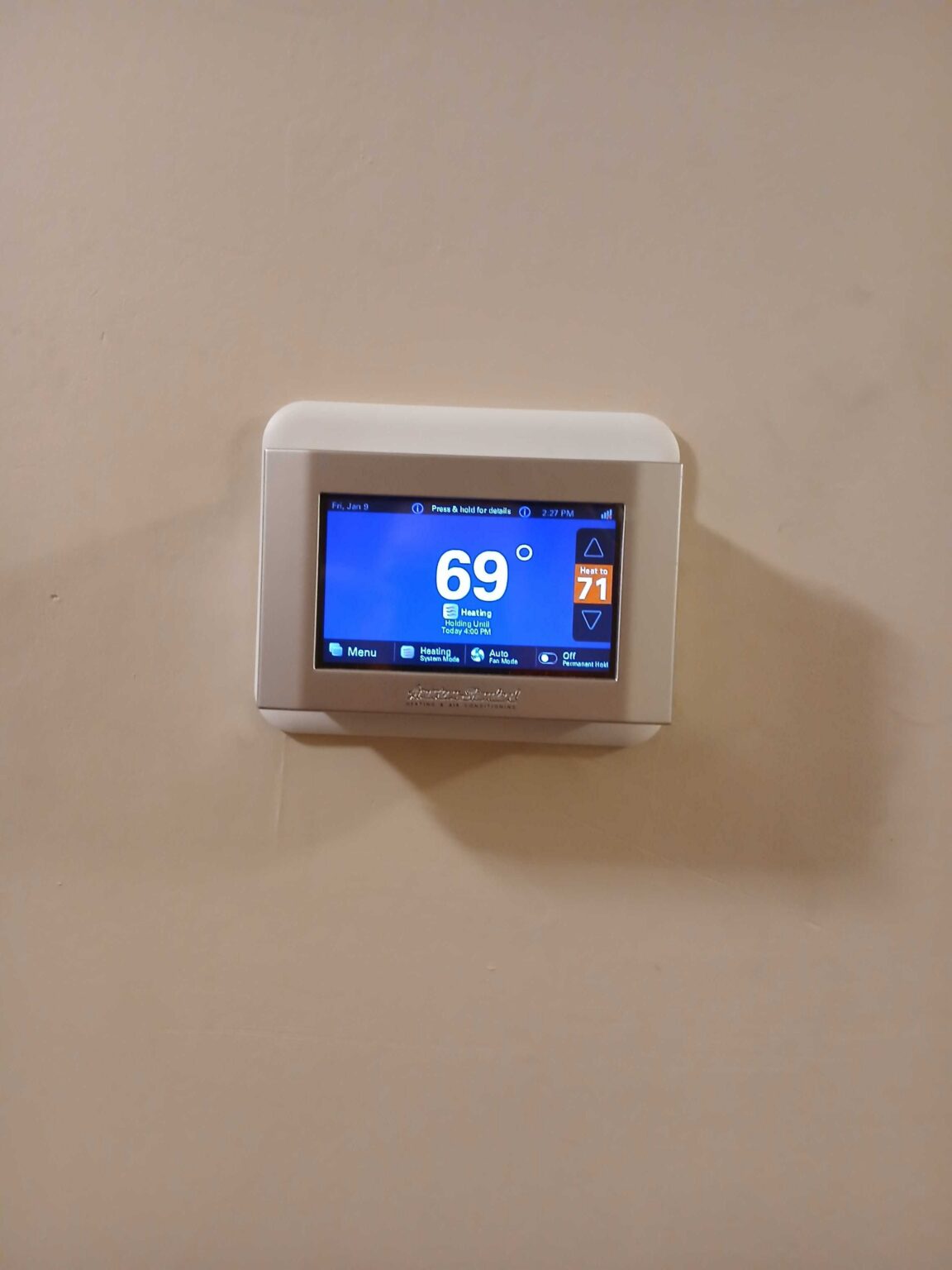
The thermostat in the hallway reads 73. The living room feels comfortable. The kitchen feels fine. But the back bedroom is sitting closer to 80, and the bonus room over the garage might as well be outside. The same AC is supposed to be cooling all of it, and on paper it is, but the experience inside the home tells a completely different story.
Hot and cold spots in a Broken Arrow, Oklahoma home are one of the most frustrating comfort complaints because the system “is working.” It runs. It produces cold air. It satisfies the thermostat. The problem is not that the AC is broken. The problem is that the air it produces is not arriving evenly across every room, and the fix almost always lives in the duct system, the return air design, or the way the thermostat is reading the home.
In this article, we cover:
- One room feels perfect while the next one feels ignored
- Adjusting the vents may make the problem move instead of disappear
- Broken Arrow heat exposes duct problems homeowners miss in spring
- The thermostat can only read the room it is sitting in
- Consistent comfort comes from measuring the imbalance
Keep reading to learn why some rooms in a Broken Arrow home stay uncomfortable even when the AC is doing its job, and what a real comfort diagnosis should look like before any equipment changes are considered.
One room feels perfect while the next one feels ignored
The clearest signal of a distribution problem is when the home cools unevenly in a predictable pattern. The same rooms are always too warm or too cold, in the same way, day after day. That predictability is actually useful. It tells the technician exactly where the imbalance lives.
Uneven temperatures often start with airflow, not the thermostat
When one room consistently underperforms while the rest of the home feels right, the equipment is almost never the cause. The AC is delivering air. Something between the equipment and the room is changing what reaches the supply register.
Patterns that point to airflow rather than equipment:
- The problem rooms are the same every season, year after year
- Cool air does come out of the supply vent but feels weak or short-volume
- Other rooms in the same wing or same floor feel normal
- Closing doors makes the problem rooms noticeably worse
- The complaint started after a remodel, an addition, or a previous HVAC service call
The diagnostic logic here matters. A failing AC produces problems in every room. A duct or balance issue produces problems in specific rooms. When the pattern is room-specific, the answer is almost always in the duct system, the return air, or the thermostat’s location, not in the cooling equipment.
A proper HVAC inspection of these symptoms should walk every room with measurement tools, not just check the equipment in the closet.
Bedrooms over garages can lose comfort faster than interior rooms
The bonus room above the garage is the single most common hot spot complaint in Broken Arrow homes. There is a structural reason for that. Garages are unconditioned spaces with thinner insulation in the ceiling, often direct exposure to the attic above, and far less thermal mass than an interior room.
What that means for cooling:
- Heat radiates up from a sun-baked garage roof and slab into the room above
- Ductwork serving the bonus room often runs through the hottest part of the attic
- The supply register may be undersized for the heat load the room actually carries
- The return path back to the system is often longer and less efficient
- The room can heat up faster during the day than the AC can keep up with
Many homes were built with a single supply vent feeding a bonus room that needed two, or with a flex duct that snakes through 30 feet of attic before reaching the room. The cool air arrives warm and underpowered. A balanced fix often involves a combination of additional supply, dedicated return, and in some cases a supplemental cooling source for that single room.
Closed doors can trap pressure and change how air moves
When supply air enters a room but has no clear path to return to the system, pressure builds inside that room and the entire airflow pattern of the home gets distorted. Bedroom doors closing at night are the most common trigger.
Here is what actually happens in a typical Broken Arrow home when bedroom doors close:
- Cool supply air keeps entering the bedrooms
- The warm air that should be returning to the central return cannot escape under the door fast enough
- Pressure builds in the bedrooms, slowing the supply airflow
- Pressure drops in the central area, and the system starts pulling return air from places it should not (attic, crawlspace, leaky returns)
- Conditioned air loses efficiency, and bedrooms still feel uncomfortable
The fix is not closing more vents elsewhere or buying a bigger system. The fix is restoring a return air path for every room with a supply vent. Transfer grilles, jumper ducts, or dedicated returns can resolve the pressure imbalance and let each room actually receive the airflow it needs. A comprehensive ventilation assessment typically identifies these conditions quickly.
Adjusting the vents may make the problem move instead of disappear
The instinct when one room is too warm is to close vents in cooler rooms and “push” more air toward the warm one. Sometimes this provides marginal relief. Usually it creates a new problem somewhere else and makes the system less efficient in the process.
Closing too many vents can raise pressure inside the ductwork
Every air conditioner is designed to move a specific volume of air through a specific duct system. When supply vents are closed, that air has fewer places to go, and the pressure inside the duct system rises. The blower starts fighting against restrictions it was never designed to handle.
What raising static pressure beyond design does to the system:
- Reduces total airflow across the cooling coil
- Forces the blower motor to work harder and run hotter
- Increases the risk of the indoor coil freezing during long cycles
- Wears the blower motor and bearings faster
- Increases noise at supply registers and in the equipment closet
The rule of thumb is to leave every supply register fully open, including in unused rooms, and address comfort issues through duct adjustments rather than register manipulation. Closing a vent feels like a fix. It is almost always making the actual problem worse.
A damper setting can send comfort to one room and starve another
Most Broken Arrow homes have manual balancing dampers in the supply trunk or branch lines. These were set during installation, often by a contractor working from rough estimates rather than measurements, and they almost never get adjusted afterward. Over time, the home’s needs change but the damper positions stay the same.
The result is that one wing of the house gets the lion’s share of conditioned air while another wing gets the leftovers. Common patterns:
- The original primary bedroom got priority airflow that now belongs to a different room
- A damper that was opened wide during construction has rusted in place
- Air handler relocations changed the duct geometry but the dampers never moved
- A previous owner adjusted dampers based on personal preference that no longer applies
- Branch additions during remodels disrupted the original balance entirely
Rebalancing through proper damper adjustment is a calibration task. A technician with airflow measurement tools can identify which dampers need to change and tune the system so the rooms that have been under-served start receiving their share. This is one of the most cost-effective comfort improvements available, and it requires no equipment changes.
Weak return air can keep cooled air from circulating evenly
Supply air is half the equation. The other half is return air, the path that warm room air takes back to the equipment to be cooled again. When the return side is undersized, restricted, or poorly located, the system cannot circulate air efficiently regardless of how much supply it produces.
Signs that return air is a weak link in a Broken Arrow home:
- A single small return grille trying to serve an entire floor
- Hallway return that is choked by a thick decorative grille
- Return ducts running through hot attics with no insulation
- Multiple bedrooms with no dedicated return path
- A filter rack with leakage allowing the system to pull air from gaps rather than the filter
When the return cannot move enough air, the entire system underperforms. Supply registers feel weak because the blower cannot pull in enough warm air to push back out as cool. Rooms farthest from the return are the first to feel it. The fix is usually adding return capacity, sealing the return path, or relocating the return grille to a better spot, none of which involves replacing the equipment.
Broken Arrow heat exposes duct problems homeowners miss in spring
In April and May, mild weather lets a marginal duct system get by. The AC runs short cycles, the demand on the system is low, and small leaks or restrictions go unnoticed. Then July arrives. Outdoor temperatures hit the upper 90s, run times stretch to 45 or 60 minutes per cycle, and every weakness in the duct system shows up as a hot or cold spot.
Attic ducts can lose cooled air before it reaches the room
Most Broken Arrow homes have ductwork running through attics that reach 130 degrees or hotter in summer. Even a well-sealed duct loses some cooling capacity over a long run through that environment. A leaky duct loses far more.
According to U.S. Department of Energy guidance on duct losses, ducts that leak conditioned air into unconditioned spaces can add hundreds of dollars a year to heating and cooling bills, and even well-sealed ducts will lose some heat, which is why energy-efficient designs increasingly route ducts inside conditioned space.
What that means in practical terms for a Broken Arrow home:
- Supply ducts that lose 15 to 20 percent of their air through small leaks
- Cool air dumped into the attic instead of reaching the supply register
- Return ducts that pull hot attic air back into the system through leaks
- Insulation that has slumped, separated, or pulled away from duct surfaces
- Long flex runs that have sagged into compressed positions, restricting flow
The rooms farthest from the air handler get hit first because their ducts are the longest and have the most opportunity to leak or lose insulation effectiveness. A targeted duct sealing pass on those branches often fixes comfort problems that have persisted for years.
Leaky connections can make distant rooms feel underpowered
Beyond the duct walls themselves, the connections between duct sections are where most leakage actually happens. Joints, register boots, plenum seams, and equipment connections all have the potential to leak when they were not properly sealed during installation or when seals have failed over time.
Visual signs that connection leakage is an issue:
- Dust streaks radiating out from supply registers on the wall or ceiling
- Attic insulation that looks dirty or matted around duct connections
- Discoloration on the duct exterior at joints and elbows
- Pieces of mastic or tape that have fallen off and accumulated below ducts
- Air noise audible at duct seams when the blower is running
Mastic sealing of accessible joints, replacing crushed sections, and tightening loose connections at register boots are all repair tasks that fall within typical HVAC repair service. They are inexpensive relative to the comfort improvement they produce, and they pay back through lower energy bills and longer equipment life.
Older duct layouts may not match how the home is used today
Many homes in Broken Arrow have been remodeled, added onto, or repurposed over the years. The kitchen got expanded. A formal dining room became a home office. A garage became living space. In most of those cases, the rooms changed but the duct system did not.
The duct system is still trying to cool the home the way the original floor plan was used. Specific patterns of mismatch:
- A converted bonus room receiving the same airflow as the original storage space
- An enlarged kitchen with the original single supply vent meant for a smaller room
- A home office with computer equipment generating heat the original room never had
- A finished basement tied into the main system through a long, undersized branch
- An addition served by a branch tapped off the closest existing trunk regardless of capacity
These mismatches cannot be fixed by adjusting the equipment. The fix is in the ducts themselves: resized supply trunks, added returns, or in some cases dedicated equipment for the spaces that have outgrown the original design.
The thermostat can only read the room it is sitting in
This is the single most underappreciated factor in hot and cold spot complaints. The thermostat is making decisions for the entire home based on the air temperature in a specific spot on a specific wall. If that spot is not representative of how the rest of the home feels, the system is going to make decisions that work against the homeowner.
A hallway thermostat may miss the hottest bedroom in the house
Most homes have the thermostat installed in a hallway or near the central return. It is a logical place from a wiring standpoint, but it is rarely the warmest or coolest part of the home. The hallway is shaded, away from windows, often near return air, and stays close to the setpoint with minimal effort.
The system sees the hallway at 73 and shuts off. The bedroom at the end of the hall sits at 78, but the equipment has already decided its work is done.
According to U.S. Department of Energy programmable thermostat guidance, homeowners can save as much as 10 percent a year on heating and cooling by adjusting setpoints when away or asleep, but those savings depend on the thermostat actually reading the conditions occupants care about. A thermostat that misses the rooms people use most cannot produce savings or comfort.
A few signs the thermostat location is part of the problem:
- The hallway is always within a degree of setpoint while bedrooms are noticeably off
- A thermometer placed in the problem room reads several degrees warmer or cooler than the thermostat
- The system shuts off shortly after starting, leaving rooms uncooled
- The same thermostat setting feels right in spring but wrong in July
- The thermostat is mounted near a return grille that pulls cooler hallway air across it
Relocating the thermostat is sometimes the right answer. Adding remote temperature sensors that report from problem rooms is another. A proper thermostat evaluation can identify whether the location, the device itself, or the wiring is contributing to the imbalance.
Sun-facing rooms can need different airflow during afternoon heat
A west-facing room in Broken Arrow takes solar heat for hours every summer afternoon. By 4 or 5 p.m., that room is carrying a significantly higher heat load than the rest of the home, and the duct system was probably designed for average load, not afternoon peak.
Symptoms of a solar-driven hot spot:
- The room feels fine in the morning and uncomfortable by mid-afternoon
- The complaint is worse on cloudless days than overcast ones
- Window treatments help significantly but do not completely solve the issue
- The room never quite catches up even after the sun moves off the windows
- Other west-facing rooms have similar but less extreme patterns
The fix is usually a combination of measures. Better window treatments or solar film reduce the heat load coming in. Increased supply airflow to that room handles more of the remaining load. In some cases, the room simply needs its own thermostat zone so the system responds to its conditions rather than averaging it with the rest of the home.
Zoning may help when balancing alone cannot solve the spread
When duct repairs, register balancing, and return improvements have been completed and certain rooms still cannot match the rest of the home, zoning becomes the next conversation. A zoned system divides the home into separate areas, each with its own thermostat and damper control, allowing the equipment to respond to actual conditions in each zone.
Zoning is the right answer when:
- The home has two distinct floors with consistently different comfort levels
- One wing of the home is used at different times than another
- A specific room (home office, gym, master suite) consistently runs out of step
- Solar exposure varies dramatically between rooms throughout the day
- The home has already had duct improvements and still has stubborn imbalances
Adding zoning to an existing system is a meaningful project, but it is also a path that solves problems balancing alone cannot. For homes with the right characteristics, it ends years of frustration in a way no other repair can.
Consistent comfort comes from measuring the imbalance
Solving hot and cold spots starts with measurement. Without numbers, every adjustment is a guess, and guesses tend to move the symptom around the home rather than eliminating it. A technician who treats comfort complaints with instruments instead of intuition produces results that last.
Temperature checks should compare supply air across problem rooms
The first measurement in any imbalance investigation is the air temperature coming out of each supply register, taken at the same time during the same cycle. A balanced system should produce roughly the same supply temperature at every register, with small variations explained by duct length.
What a thorough supply temperature check should reveal:
- Each register’s supply temperature within 2 to 3 degrees of the others
- A consistent difference between supply and return air (the “split”), typically 18 to 22 degrees
- No registers producing significantly warmer or significantly colder air than others
- Air volume at each register matching the design CFM for that room
- No fluctuating temperatures that indicate duct leakage or air entrainment
When one register’s supply temperature is markedly warmer than the others, the duct serving it is losing cooling capacity somewhere along the run. That is a duct repair, not an equipment issue.
Static pressure readings can reveal a system fighting restricted airflow
Static pressure is the resistance the blower has to overcome to move air through the duct system. Every system has a maximum static pressure rating from the manufacturer, and operating above that rating means the system is fighting too much resistance.
What high static pressure looks like in real terms:
- The blower runs harder and louder than it should
- Total airflow drops below what the cooling coil needs
- The coil can drop below freezing during extended cycles
- Energy use climbs because the motor is working against restrictions
- Comfort suffers because each room receives less air than designed
A homeowner cannot measure this from outside the equipment, but a technician with a manometer can take a reading in under five minutes. That reading, combined with airflow measurements at each register, produces a complete picture of where the system is struggling and what specific fixes will return it to design performance.
Air balancing should fix the cause, not just hide the complaint
The difference between a real balance and a quick adjustment is the difference between solving a problem and rearranging it. A proper balance:
- Starts with documented measurements at every supply and return
- Identifies the actual cause of the imbalance (leakage, restriction, sizing, location)
- Repairs the underlying issue before adjusting dampers or registers
- Confirms the result with a second round of measurements
- Leaves the homeowner with a record of what was done and why
A quick adjustment, by contrast, closes a vent here, opens a damper there, and hopes the next call from the homeowner is about something different. The complaint may move from one room to another, but it does not go away.
The best HVAC service relationships include periodic checks of system performance that catch developing imbalances before they become comfort complaints. A system that was perfectly balanced three years ago has probably drifted since then, and small drift becomes large discomfort during the hottest stretches of summer.
Conclusion
Hot and cold spots in a Broken Arrow home are not a sign that the AC needs to be replaced. They are a sign that the path between the equipment and the rooms has either changed or was never quite right in the first place.
The fix lives in the duct system, the return air design, the thermostat placement, and the balance of the entire distribution network, not in the cooling capacity of the unit outside.
Most uneven cooling problems in Broken Arrow trace back to a small number of causes: duct leakage in hot attics, undersized supply to specific rooms, return air restrictions, damper settings that have drifted, and thermostats that read the wrong part of the home.
Each one has a targeted fix that costs less than equipment replacement and produces more comfort than chasing the symptom with thermostat adjustments.
The homeowners who solve comfort imbalances for good are the ones who stop accepting “that room is just always hot” as a permanent condition.
The room is not just always hot. Something specific is preventing it from getting its share of conditioned air, and that something can be identified, measured, and fixed by a technician who treats comfort as a measurement problem rather than a guessing game.
Done right, the whole home reaches the same comfortable temperature on the same cycle, and the experience inside the house finally matches what the thermostat has been claiming all along.
When certain rooms refuse to match the rest of the home, Kinty Jones provides full airflow, duct, and thermostat diagnostics across Broken Arrow and the surrounding service area. Request a service visit today and get a real measurement of where the imbalance is and how to fix it.