A clogged air filter is the single most common and most preventable cause of residential HVAC problems in Rogers, and how clogged filters affect airflow goes far beyond a slightly dusty house. When the filter that sits between your return vent and the evaporator coil fills with dust, pet hair, pollen, and debris, it chokes the airflow your system needs to function. The blower works harder, the evaporator coil gets colder than it should, energy consumption climbs, and every component downstream of that filter pays the price.
The U.S. Department of Energy states that replacing a dirty filter with a clean one can reduce an air conditioner’s energy consumption by 5% to 15%. That is a significant range, and it means a Rogers homeowner paying $200 a month in summer electricity could be wasting $10 to $30 every month on energy that a $5 filter would have saved.
What makes this problem worse is that it develops gradually. A filter does not go from clean to catastrophically clogged overnight. It loads up over weeks, and the airflow reduction is so incremental that most homeowners do not notice the decline until the system starts showing obvious symptoms like warm air from the vents, ice on the coil, or rooms that never reach the set temperature.
In this article, you will learn about:
- What happens inside your HVAC system when the filter clogs
- The chain reaction of damage that starts with restricted airflow
- How a dirty filter affects your energy bills, your comfort, and your health
- The right filter change schedule for Rogers homes
- When filter problems point to something bigger that needs professional attention
Keep reading to understand why the cheapest part in your HVAC system has the biggest impact on how it performs.
What happens inside your HVAC system when the filter clogs
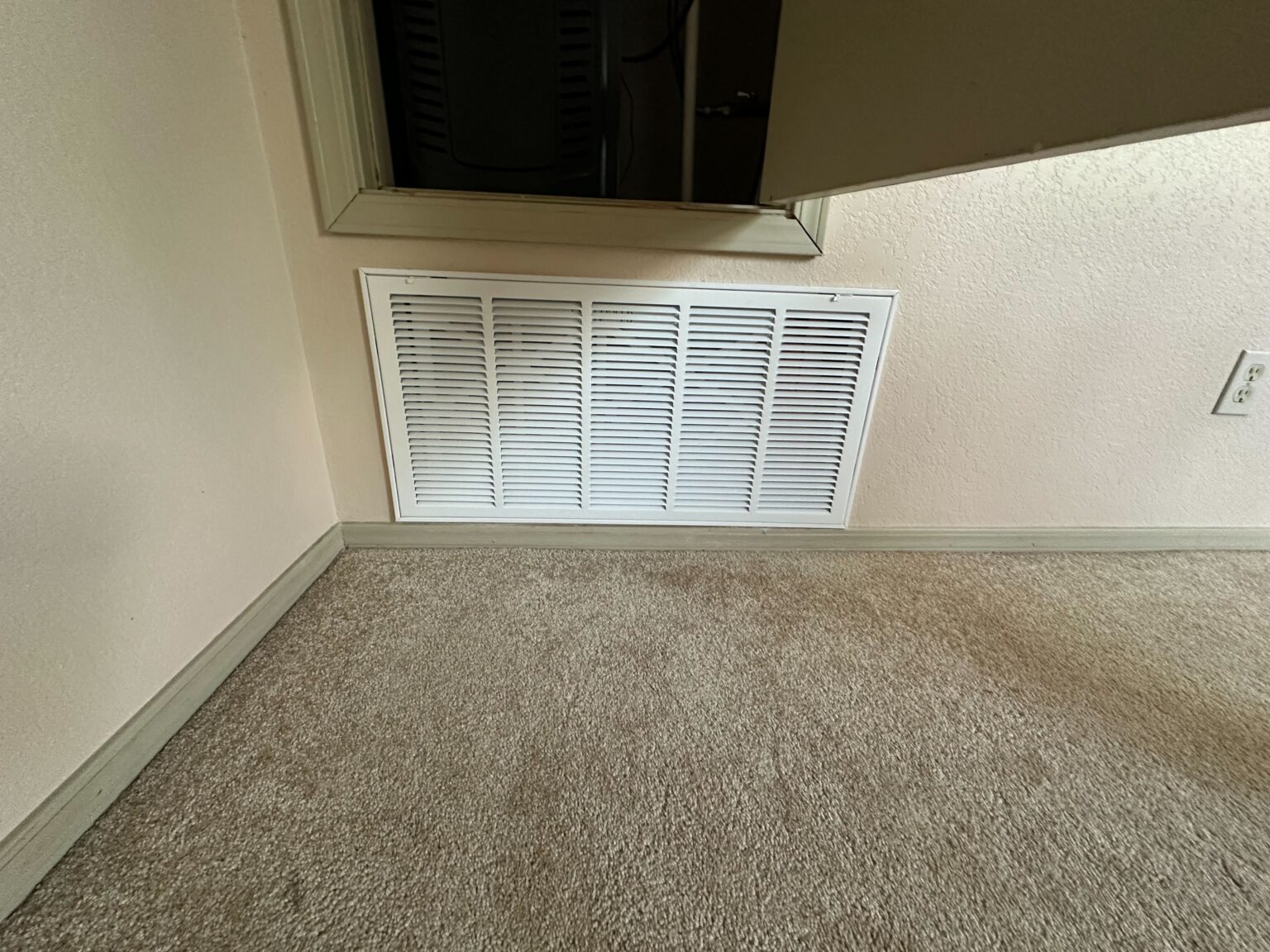
Your air filter sits in the return air path, between the return grille and the evaporator coil. Every cubic foot of air your system circulates passes through that filter first. When the filter is clean, air moves through with minimal resistance and reaches the evaporator coil at the volume and velocity the system was designed for. When the filter clogs, that volume drops, and the effects cascade through every component in the system.
Understanding this chain reaction explains why a $5 filter can cause hundreds or thousands of dollars in damage when it is neglected.
The blower motor works harder but moves less air
The blower motor is designed to push a specific volume of air, measured in cubic feet per minute, through the duct system. When a clogged filter creates resistance, the blower has to work harder to pull air through. In systems with standard PSC motors, the motor cannot compensate for the added resistance, so airflow drops proportionally as the filter loads up.
In systems with ECM or variable-speed motors, the motor ramps up its speed to try to maintain airflow, which partially compensates for the restriction but dramatically increases electricity consumption. Either way, the homeowner loses.
The practical effects of reduced blower performance:
- Supply vents throughout the house blow weaker than normal
- The system runs longer cycles because it takes more time to move enough air to satisfy the thermostat
- The blower motor draws more power and runs hotter, which shortens its lifespan
- You hear the system working but the house never quite reaches the temperature you set
If you have noticed that your HVAC system seems to struggle during peak afternoon heat in Rogers, check the filter before assuming the system itself has a problem. A filter that has been in place for three or four months during the summer cooling season is almost certainly restricting airflow.
The evaporator coil drops below freezing and ice starts forming
This is where a clogged filter turns from an efficiency problem into a mechanical emergency. The evaporator coil relies on a steady stream of warm indoor air passing across its surface to absorb heat and stay above 32 degrees. When a dirty filter cuts that airflow, the coil cannot absorb enough heat, its temperature drops below freezing, and moisture in the air freezes on the coil surface.
Once ice starts forming, it blocks even more airflow, which causes the coil to get even colder, which causes more ice to form. The cycle accelerates rapidly and can freeze the entire coil solid within a few hours.
Signs that a dirty filter has caused your coil to freeze:
- Warm air blowing from the supply vents despite the system running
- Visible frost or ice on the larger copper refrigerant line near the indoor unit
- Water pooling around the air handler as ice begins to melt during off cycles
- The system shutting off on a safety switch and refusing to restart
Frozen coils in Northwest Arkansas are one of the most common summer service calls, and the filter is the cause in the majority of cases. Catching a clogged filter before it triggers a freeze saves the cost of an emergency visit and protects the compressor from the stress of running against a frozen coil.
Dust bypasses the filter and coats the coil, compounding the problem
When a filter is severely clogged, the pressure difference across it can cause the filter to warp, pull away from its housing, or develop gaps at the edges. When that happens, unfiltered air bypasses the filter entirely and carries dust, debris, and particulates directly onto the surface of the evaporator coil.
A dirty evaporator coil is a much bigger problem than a dirty filter. The dust layer on the coil acts as insulation, reducing the coil’s ability to absorb heat from the air even after you replace the filter. At that point, restoring proper performance requires a professional coil cleaning, which is more expensive and more involved than simply swapping a filter.
This is why regular filter changes are not just about the filter itself. They protect the components behind the filter, the coil, the drain pan, the blower wheel, and the ductwork downstream, from contamination that is much harder and costlier to clean once it accumulates.
The chain reaction of damage that starts with restricted airflow
A clogged filter does not just reduce airflow. It sets off a cascade of secondary effects that touch your energy bills, your equipment lifespan, your indoor comfort, and your indoor air quality. Each effect compounds the others, which is why a filter that has been neglected for a full summer can cause problems that persist long after the filter is finally replaced.
The damage is cumulative. The longer the filter sits, the worse every downstream effect becomes.
Energy bills climb because the system runs longer and harder
When airflow drops, the system needs more time to cool the same space. A system that would normally cycle for 15 minutes and rest for 10 now runs for 25 minutes and rests for 5, or runs nearly continuously during peak afternoon heat. Every additional minute of runtime is additional electricity consumption.
According to the DOE, efficiency standards exist specifically because even small reductions in cooling performance translate into significant energy waste across millions of homes. In a single Rogers household, a clogged filter during June, July, and August can add $30 to $90 to summer electricity costs depending on how severely the filter is loaded and how many hours the system runs each day.
The math is straightforward:
- A clean filter allows the system to cool efficiently in shorter cycles
- A clogged filter forces longer cycles at reduced capacity
- Longer cycles at reduced capacity use more electricity to produce less cooling
- The homeowner pays more for less comfort
This is not a theoretical problem. It shows up directly on your utility bill, and it is fully preventable with a filter change that takes less than five minutes.
The compressor takes the hit when the system runs under stress
The compressor is the most expensive single component in your air conditioning system, and it is also the component most vulnerable to the operating conditions a clogged filter creates. When the evaporator coil cannot absorb enough heat because of restricted airflow, liquid refrigerant can return to the compressor instead of being fully evaporated.
This condition, called liquid slugging, forces the compressor to process liquid that it was designed to handle only as a gas. The mechanical stress on the compressor’s internal components is severe, and repeated slugging events can cause premature compressor failure.
Compressor replacement in a residential AC system is one of the most expensive repairs a homeowner can face. In many cases, it is more cost-effective to replace the entire outdoor unit or the whole system than to replace the compressor alone. All of that potential cost traces back to a filter that was not changed on time.
If your system has been running with restricted airflow and you notice unusual noises from the outdoor unit, contact a professional for an AC system inspection before the compressor sustains permanent damage.
Uneven room temperatures get worse as airflow drops
Reduced airflow does not affect every room equally. The rooms closest to the air handler, typically the hallway where the thermostat is located, still receive enough cooled air to stay relatively comfortable. The rooms at the end of long duct runs, usually bedrooms and bonus rooms, receive the least airflow and show the biggest temperature increase.
This means a clogged filter amplifies existing hot spots in the home and makes rooms that were already marginal noticeably uncomfortable. The thermostat in the hallway is satisfied, but the back bedroom is five or six degrees warmer.
If you have noticed that certain rooms in your Rogers home feel warmer than others, check the filter before investigating ductwork or insulation. Restoring full airflow by replacing a clogged filter often resolves or significantly reduces uneven temperature problems without any other intervention.
How a dirty filter affects your comfort, your health, and your air quality
The performance and mechanical consequences of a clogged filter are serious, but the effects on indoor air quality and personal comfort matter just as much. The filter’s primary job is to remove airborne particles from the air your family breathes, and when the filter is overloaded, it stops doing that job effectively.
In a climate like Rogers, where summer humidity and pollen are both elevated, the air quality impact of a neglected filter is noticeable.
Allergens and particulates recirculate instead of being captured
A clean filter traps dust, pollen, pet dander, mold spores, and other airborne particulates as air passes through. When the filter is fully loaded, it can no longer capture additional particles effectively. Some particles pass through the saturated media, and others bypass the filter entirely through gaps created by the pressure differential.
The result is that the air circulating through your home carries a higher concentration of allergens and irritants, which is the opposite of what the filter is supposed to do.
Populations most affected by degraded filtration:
- Allergy sufferers who rely on their HVAC system to reduce indoor pollen and dust exposure
- Asthma patients whose symptoms are triggered by airborne particulates
- Young children and older adults with developing or compromised respiratory systems
- Pet owners whose homes produce higher volumes of dander and hair
The EPA recommends that HVAC maintenance, including regular filter changes, is a core component of maintaining healthy indoor air quality. A home where the filter is changed monthly during the cooling season will have measurably cleaner indoor air than one where the filter sits for a full summer.
Humidity control degrades because the coil cannot do its job
Your air conditioner removes humidity as a byproduct of the cooling process. Warm, humid air passes over the cold evaporator coil, moisture condenses on the coil surface, and the dehumidified air is distributed through the house. When a clogged filter reduces the volume of air reaching the coil, the system removes less moisture per cycle.
The home may reach the thermostat temperature but still feel sticky and uncomfortable because the humidity is not being controlled effectively. This is especially noticeable in Rogers during June and July when outdoor humidity is at its highest.
A clean filter restores the airflow the coil needs to dehumidify effectively. If the sticky feeling persists even with a fresh filter, the system may need professional attention to check refrigerant levels, coil condition, or whether the system is properly sized for the home’s humidity load.
The condensate drain works harder and clogs faster
More moisture on the coil means more water in the drain pan and more volume flowing through the condensate drain line. A dirty filter that also allows dust to reach the coil creates the perfect conditions for a condensate drain clog: the water carries dust and biological matter from the coil surface into the drain line, where it builds up over time.
A clogged condensate drain can trigger a float switch that shuts the system off entirely, or in homes without a float switch, it can cause water to overflow the drain pan and leak into the ceiling, walls, or floor below the air handler.
Keeping the filter clean reduces the dust reaching the coil, which reduces the debris entering the condensate drain, which extends the time between drain cleanings. It is a simple cause-and-effect chain that starts with a clean filter.
The right filter change schedule for Rogers homes
There is no universal answer to how often you should change your air filter because the right interval depends on your home, your family, and how hard your system works. But there are clear guidelines based on the conditions that are common in Rogers and across Northwest Arkansas.
The baseline recommendation is to check the filter monthly and replace it when it shows visible dust loading. For most Rogers homes during the cooling season, that means replacing the filter every 30 to 60 days.
Factors that shorten your filter life in Rogers
Several factors common to Rogers and Northwest Arkansas accelerate how quickly your filter loads up during the summer:
- Pets that shed heavily, particularly dogs and cats that spend time indoors
- New construction, road work, or landscaping activity near your home that generates airborne dust
- A home surrounded by mature trees that produce pollen, seeds, and organic debris
- A system that runs 16 or more hours a day during peak summer heat
- A larger household with more people generating dust, dander, and particulates
If any of these apply to your home, checking the filter every two to three weeks during June, July, and August is a reasonable precaution. A filter that looks clean at two weeks does not need to be replaced, but one that is visibly gray or loaded should come out immediately.
A reusable or washable filter requires the same inspection schedule. Rinse it thoroughly and let it dry completely before reinstalling. A damp filter can promote biological growth inside the air handler.
Choosing the right MERV rating without strangling your system
Not every filter is the right filter for every system. The MERV rating indicates how effectively a filter captures particles of different sizes, with higher numbers capturing smaller particles. But higher MERV ratings also create more airflow resistance, and installing a filter with too much resistance for your blower can restrict airflow almost as badly as a dirty lower-rated filter.
The Building America Solution Center, a program supported by the U.S. Department of Energy, notes that the filter’s contribution to total system pressure drop is typically 20% to 50%, and most residential systems are designed to operate below 0.5 inches of water column total static pressure.
A practical guide for Rogers homeowners:
- MERV 8 is the standard recommendation for most residential systems and provides solid filtration for dust, pollen, and pet dander
- MERV 11 offers improved capture of smaller particles and is a good choice for homes with pets or mild allergy concerns
- MERV 13 captures very fine particulates but creates significantly more resistance and should only be used if your system’s blower can handle the added pressure drop
- If you want better filtration without more resistance, use a deeper filter housing that accepts 4-inch or 5-inch pleated filters instead of the standard 1-inch size
Your HVAC technician can measure the static pressure in your system with the filter installed to confirm that the filter you are using is not creating more resistance than the blower can handle. This is a quick test that is typically included in a professional tune-up.
Set a reminder and make it automatic
The most effective filter change schedule is the one you actually follow. Set a recurring calendar reminder on the first of every month from May through October. Check the filter, replace it if it shows any visible loading, and move on. The whole process takes less than five minutes.
Some homeowners find it easiest to buy a six-pack of filters at the start of the cooling season and keep them next to the air handler. Eliminating the trip to the hardware store removes the most common excuse for skipping the change.
If you have trouble remembering or want the accountability of a professional keeping track, a maintenance membership builds filter checks into your scheduled seasonal service visits.
When filter problems point to something bigger
In most cases, replacing the filter resolves the issue and the system returns to normal. But sometimes a filter-related problem is a symptom of a deeper issue that a new filter alone will not fix. Knowing when to call a professional prevents you from chasing a filter problem when the real cause is elsewhere.
The general rule is simple. If you replace the filter and the symptoms go away, the filter was the problem. If the symptoms persist or recur quickly, something else is going on.
The filter gets dirty unusually fast
If a new filter loads up completely in two weeks or less, the filter is not the problem. Something is driving excessive dust or debris into the system faster than a normal filter cycle can handle.
Possible causes of accelerated filter loading:
- Ductwork leaks in the attic or crawl space pulling in unfiltered outside air and insulation particles
- An undersized return grille that creates high air velocity and draws more dust through the filter
- Poor sealing around the filter housing that allows unfiltered air to bypass the filter entirely
- Renovations, drywall work, or construction in or near the home generating abnormal dust levels
A technician can inspect the duct system, measure the return air velocity, and check the duct connections for leaks that are introducing contamination into the system.
The system still struggles after a clean filter is installed
If you replace the filter and the house still does not cool properly, the problem has moved beyond the filter. The dirty filter may have allowed dust to accumulate on the evaporator coil, which now needs professional cleaning to restore heat transfer. Or the restricted airflow may have stressed the compressor or blower motor to the point where a component has degraded.
A thorough AC diagnostic at this point should include measuring airflow at the supply vents, inspecting the evaporator coil for buildup, checking the refrigerant charge, and testing the blower motor’s amp draw and speed. These tests identify exactly what the dirty filter damaged so the repair targets the right component.
Annual tune-ups catch what monthly filter checks miss
Changing the filter monthly keeps the most common problem at bay, but it does not replace the value of having a professional inspect the full system once a year. A spring tune-up for the heating side and a pre-summer inspection for the cooling side catch wear, refrigerant loss, electrical degradation, and coil contamination that no filter change can address.
A qualified technician will also verify that your filter is the right size and MERV rating for the system, that the filter housing seals properly, and that the return airflow meets the system’s design specification. These checks take minutes during a routine visit but prevent the kind of cascading damage that starts with a filter problem and ends with a major repair or system replacement.
Conclusion
A clogged air filter is the cheapest part of your HVAC system and the one with the most outsized impact on performance, efficiency, and equipment life. In Rogers, where summers push systems hard for four to five months straight, a filter that sits too long can trigger frozen coils, compressor stress, spiking energy bills, degraded air quality, and rooms that never reach a comfortable temperature.
The fix is simple, cheap, and fast. Check the filter monthly from May through October. Replace it when it shows any visible dust loading. Buy a six-pack at the start of the season so you always have a spare.
If your system has been struggling this summer and you are not sure whether the filter is the full story, Kinty Jones Heating and Cooling serves Rogers and Northwest Arkansas homes with the kind of thorough diagnostic work that finds out exactly what is happening inside the system and fixes it right. Whether it is a filter, a coil, a refrigerant issue, or something else entirely, the team will tell you what it is and what it costs before any work begins.