The first sign of HVAC trouble in a commercial building is rarely the equipment shutting down. It is a quiet drift. The office feels warmer than it used to in late afternoon. The electric bill creeps up by 8 percent. An employee leaves early because the conference room is unbearable after lunch. None of it triggers a panic. All of it is the building telling the operator that the system is heading somewhere unwanted.
Commercial HVAC maintenance in Springdale, Arkansas is the difference between a building that quietly performs year after year and one that produces a string of comfort complaints, surprise repair invoices, and after-hours emergency calls during the worst heat of summer. Preventive maintenance is not a line item. It is the practice that protects everything that depends on the building being open, comfortable, and operating.
In this article, we cover:
- A warm office usually started wasting energy before anyone complained
- Small maintenance misses can turn into business interruptions
- Utility bills can reveal HVAC trouble before the equipment does
- Different commercial spaces need different maintenance priorities
- Preventing downtime means documenting what changed since the last visit
Keep reading to learn what commercial HVAC maintenance actually looks like in practice, where Springdale businesses tend to lose efficiency first, and how to set up a service plan that catches problems before they become business interruptions.
A warm office usually started wasting energy before anyone complained
By the time the first complaint reaches facilities, the system has usually been underperforming for weeks. The shift happens slowly enough that no one notices until comfort crosses a threshold. The energy waste, on the other hand, starts the day a problem develops, and it keeps accumulating until someone catches it.
Longer run times can signal declining performance before a breakdown
Commercial rooftop units that ran 60 percent of the time last July may be running 80 percent of the time this July. The change is invisible from inside the building, but it shows up clearly in utility data and run-time records. Something has shifted: a slow refrigerant leak, a coil that has lost airflow, a damper stuck partially closed, or insulation that has degraded enough to change the building’s load profile.
What extended run times usually point to:
- A refrigerant charge that has dropped 10 to 15 percent below specification
- A condenser coil partially blocked by dust, leaves, or building debris
- An economizer damper stuck in the wrong position for current outdoor conditions
- A failing capacitor producing reduced compressor output
- Building envelope changes (added equipment, more occupants, new lighting) that increased the load
According to ENERGY STAR research on commercial buildings, about 30 percent of the energy used by a typical commercial building is wasted through inefficiencies, and a meaningful share of that waste lives in HVAC systems that have drifted from their designed performance. Catching that drift through routine inspection is one of the most cost-effective things a facility can do.
A maintenance program that includes run-time tracking and trending often spots the developing problem before any occupant feels it.
Uneven comfort can distract employees and frustrate customers
In an office, hot conference rooms cause meetings to end early. In a retail space, an uneven sales floor pushes customers toward the door faster than the layout intended. In a restaurant, kitchen heat that bleeds into the dining room changes how long guests stay. Comfort is not a soft metric. It directly affects business outcomes.
Patterns that point to maintenance-driven comfort issues:
- One zone of the building consistently runs warmer or colder than others
- Comfort drifts as outdoor temperatures climb, even within the system’s design range
- The same spots feel uncomfortable on the same days each week (a clue about scheduling)
- Complaints concentrate in spaces that share a single unit or zone
- Returning to comfortable conditions after a weekend takes longer than it used to
Most of these are repairable through cleaning, calibration, and balancing rather than equipment replacement. A proper HVAC inspection process on a commercial system identifies the cause behind the comfort drift and prioritizes the fixes that produce measurable improvement.
Dirty coils make rooftop units work harder during Springdale heat
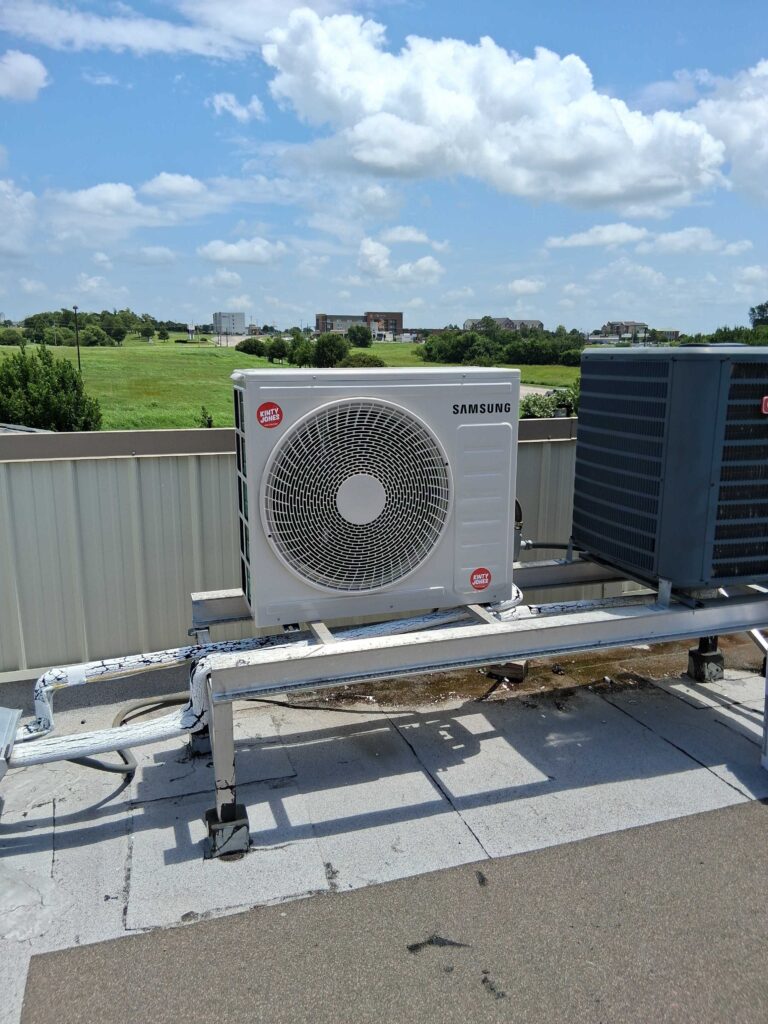
Rooftop HVAC units operate in some of the harshest conditions in commercial cooling. They sit in direct sun, breathe through coils exposed to pollen, dust, cottonwood fluff, exhaust grease, and whatever else moves through Springdale’s summer air. Without routine cleaning, those coils lose their ability to transfer heat efficiently.
What a dirty coil costs a commercial building:
- The compressor runs longer to deliver the same amount of cooling
- Head pressures rise, stressing the compressor and increasing electrical demand
- The unit may trip on high-pressure safety during peak afternoon heat
- Refrigerant lines and valves see higher operating temperatures
- The unit’s expected service life shortens by years
A coil cleaning takes time, but it is one of the highest-return maintenance tasks available. The capacity recovered is capacity the building is already paying for through the electric bill but not receiving in comfort. A scheduled commercial maintenance visit treats coil cleaning as a routine part of pre-season preparation, not a corrective task triggered by complaints.
Small maintenance misses can turn into business interruptions
The components that fail and shut down a commercial system are rarely the expensive ones. They are the inexpensive ones that did not get checked. A $20 capacitor that was due for replacement six months ago can take down a compressor worth thousands. A drain line that was supposed to be flushed in May can shut down a unit in July.
Loose electrical connections can shut down cooling without warning
Vibration is the constant enemy of rooftop and packaged equipment. Years of compressor cycling, blower operation, and outdoor temperature swings work loose at electrical terminals, lugs, and connectors. A connection that is 90 percent tight today can be 70 percent tight in six months, and the resistance at that connection generates heat that eventually melts insulation or burns out the contact.
Common electrical failures that originate in routine missed maintenance:
- A contactor whose points have pitted and welded shut, or arcing intermittently
- Capacitor terminals that have corroded and lost continuity
- Wire nuts on the control side that have backed off enough to cut the signal
- A safety switch that has loosened on its mount and is no longer reliably tripping
- Compressor terminals showing oxidation that increases starting amperage
These are five-minute repairs during a scheduled maintenance visit. They are also the source of most “the AC just stopped working” emergency calls. A maintenance program that tightens and tests every electrical connection annually almost eliminates this category of failure.
Clogged drains can create leaks above offices, inventory, or equipment
Every commercial cooling unit produces condensate. Rooftop units route that water through drain lines that often run across roofs, through ceiling cavities, or down equipment chases. When those lines clog with biological growth or debris, the water has to go somewhere, and that somewhere is rarely a place that can absorb it without damage.
What a clogged condensate drain can cost a commercial space:
- Water damage to ceiling tiles directly below the unit
- Mold growth in the ceiling cavity that triggers indoor air quality issues
- Damage to inventory, paperwork, or electronics stored under the failure point
- Shutdown of the unit when the safety float switch trips repeatedly
- Insurance claims and downtime that dwarf the cost of the maintenance miss
Flushing condensate drain lines and inspecting drain pans is routine work during a scheduled maintenance visit. It is also one of the most overlooked tasks when a building tries to save money by skipping maintenance. The savings on the skipped visit almost never cover the cost of even a single drain failure event.
Worn belts and motors often fail when the building is busiest
Belt-driven blowers and condenser fans are common in commercial equipment, and the belts themselves wear continuously. They stretch, glaze, crack, and slip over time. Bearings in motors and fans develop play and eventually seize. Both failures tend to happen during peak demand, when the equipment is running the hardest.
Signs of impending belt and motor issues that maintenance visits should catch:
- Belt tension that has loosened past specification
- Visible cracking or glazing on belt surfaces
- Unusual noise from bearings under load
- Slight vibration that did not exist at the last inspection
- Discoloration or burn marks on pulleys or motor mounts
These are predictable failures. A maintenance technician with a tension gauge, a stethoscope, and ten minutes of inspection time can identify the next failure long before it happens. Belts and bearings are inexpensive and replaceable on a planned schedule. The same components, replaced after a failure during business hours, cost the building far more in downtime than the parts ever did.
Utility bills can reveal HVAC trouble before the equipment does
Energy bills are one of the earliest warning systems available to a commercial building operator. A system that is losing efficiency shows up in the bill before it shows up in comfort complaints. A building that learns to read its own utility data catches problems months earlier than one that waits for occupants to notice.
Rising costs may point to restricted airflow or neglected filters
A monthly electric bill that climbs 10 to 15 percent against the same month a year ago, with no change in occupancy or weather, is almost always reflecting a degraded HVAC system. The most common cause is restricted airflow, and the most common source of restriction is the filter.
What dirty or restricted filters cost a commercial building:
- The blower works harder against increased static pressure, drawing more current
- The cooling coil sees less air, reducing its heat transfer effectiveness
- Run times extend because the system delivers less cooling per cycle
- The blower motor lifespan shortens due to the increased load
- Indoor air quality suffers as the system bypasses or struggles against the filter
According to ENERGY STAR, space cooling accounts for roughly 15 percent of electricity used in commercial buildings, second only to lighting. When that 15 percent slice starts climbing, the cause is almost always inside the HVAC system. A maintenance program with a defined filter replacement schedule typically pays for itself in avoided utility costs alone.
Poor scheduling can make systems cool empty rooms after hours
A surprising amount of commercial cooling energy is spent maintaining comfortable conditions in unoccupied spaces. Conference rooms cooled all weekend. Office floors cooled overnight to the same temperature as the workday. Retail spaces conditioned for a customer load that left hours ago.
A well-maintained system pairs equipment performance with intelligent scheduling. Common scheduling improvements that maintenance visits can address:
- Programming setbacks for nights, weekends, and holidays
- Verifying that scheduled setbacks actually trigger reliably
- Adjusting morning warm-up or cool-down to use the minimum runtime needed
- Coordinating zones so that unused areas are not cooled by default
- Using occupancy sensors to trigger setbacks in conference rooms and break areas
These adjustments do not require new equipment. They require a technician who reviews the schedule against actual usage patterns and makes the system match how the space is used today, not how it was used three years ago.
Rooftop units need airflow and coil checks before peak demand
By the time July arrives, the maintenance window for catching summer problems has closed. A commercial rooftop unit that is going to struggle through peak demand needs its airflow, coil condition, and refrigerant charge verified in April or May, not July.
What a pre-season rooftop inspection should include:
- A full coil cleaning on both the condenser and the evaporator
- Refrigerant pressure and superheat/subcooling verification
- Belt tension and wear inspection on all drive belts
- Bearing condition check on all motors and fans
- Damper position verification on economizers and outside air controls
- Control system testing including all safety switches and limit controls
A unit that has been through this kind of inspection in spring tends to make it through the entire summer without an emergency call. A unit that has not is the one that calls the property manager at 4 p.m. on the hottest day of the year, after most of the staff has gone home.
Different commercial spaces need different maintenance priorities
A maintenance plan that works for a small office does not necessarily work for a restaurant or a retail store. The equipment may be similar, but the loads, the contaminants, the comfort requirements, and the operating hours differ enough that the maintenance approach has to fit the building.
Restaurants put more grease, heat, and moisture into the air
Commercial kitchens generate enormous heat loads. They also produce airborne grease that coats coils, fans, and filters far faster than office environments do. A restaurant rooftop unit handling a kitchen exhaust load needs maintenance frequency that an office unit would never require.
What a restaurant HVAC maintenance plan typically includes that an office plan does not:
- More frequent coil cleaning, sometimes quarterly rather than annually
- Special attention to grease accumulation on outdoor fan blades and motor housings
- Additional filter changes during periods of heavy cooking volume
- Verification of makeup air balance against exhaust hood operation
- Inspection of ductwork in kitchen areas for grease buildup or corrosion
A restaurant that maintains its HVAC on a typical office schedule almost always ends up with reduced capacity, premature equipment failure, and indoor air quality complaints from the dining area. A plan built around the actual kitchen load addresses those issues before they affect service.
Retail spaces need comfort that holds steady through door traffic
Retail environments lose conditioned air every time the front door opens. In Springdale summers, that opening means a rush of 90-plus degree air across the threshold, and the system has to recover quickly without making the space uncomfortable while it does.
Maintenance priorities specific to retail:
- Verifying that air curtains or vestibules are functioning properly
- Inspecting and rebalancing supply air patterns near entrance areas
- Confirming that economizers are not pulling in excess hot outside air
- Testing that the system can recover quickly after door-opening events
- Calibrating thermostat locations away from direct airflow or solar exposure
A retail space that maintains comfortable conditions through busy weekends without obvious temperature swings is almost always one with a well-maintained system. Customers notice the difference, even when they cannot articulate it.
Offices often need better zoning before thermostat complaints stop
Office buildings tend to accumulate comfort complaints as they age, particularly if the original zoning has not been revisited as floor plans changed. Cubicles became private offices. Conference rooms moved. Sun-facing spaces took on more glass. The HVAC zones, meanwhile, stayed exactly as they were installed.
Office-specific maintenance considerations:
- Reviewing zone boundaries against current floor plans
- Checking that thermostats are located in spaces representative of their zones
- Verifying VAV (variable air volume) boxes if installed are calibrated and responsive
- Assessing whether new heat-generating equipment (servers, copiers, kitchens) has shifted loads
- Testing that after-hours setbacks actually engage and disengage on schedule
A maintenance visit that includes a review of zoning and load distribution often solves chronic complaints that previous service calls only treated as comfort issues. The underlying mismatch between zones and spaces is the real cause, and maintenance is the right time to identify it.
Preventing downtime means documenting what changed since the last visit
The single biggest difference between commercial HVAC maintenance that prevents downtime and maintenance that only delays it is documentation. A program that captures what was found, what was done, and what trended over time is a program that catches developing failures. A program that only checks boxes on a generic form does not.
Maintenance records help catch repeat failures before they become expensive
Every commercial system has its own failure profile. Some units lose refrigerant on a predictable schedule. Some have a specific contactor that fails every two to three years. Some develop coil contamination from a particular environmental source. Documentation makes these patterns visible.
What good maintenance records should capture:
- Refrigerant charge measurements at each visit, with trends over time
- Static pressure and airflow readings at the same points each visit
- Electrical readings on key components (compressor amps, capacitor microfarads)
- A list of every part replaced and the date of replacement
- Photographs of coil condition, belt wear, and any developing concerns
- Notes on building changes that may have affected load
When the same unit shows the same problem twice within a few years, the records make the pattern obvious. Without records, each failure looks like a one-time event and gets treated as one. With records, the underlying cause becomes the actual repair target.
Filter, belt, and refrigerant trends tell a clearer story than one inspection
A single maintenance visit captures a snapshot. A series of visits captures a trend. Trends are what reveal whether a system is stable, drifting, or heading toward a specific failure.
What different trend patterns reveal:
- Static pressure climbing year over year: developing duct restriction or filter rack leakage
- Refrigerant charge dropping at a consistent rate: a slow but real leak
- Compressor amperage rising at the same setpoint conditions: developing internal wear
- Coil temperature differential narrowing: declining heat transfer effectiveness
- Belt replacement intervals shortening: alignment or load issues developing
A maintenance provider who reviews these trends with the building operator transforms maintenance from a service call into a planning conversation. Decisions about repair, replacement, and capital investment become driven by data rather than emergencies.
A service plan should fit business hours, access needs, and equipment age
A great commercial maintenance plan reflects the specific building it serves. It accounts for when the space can be accessed, what the equipment can tolerate, and where the building is in its overall lifecycle. Plans that ignore those factors produce friction with operations and rarely deliver the consistent maintenance the equipment needs.
Elements of a well-designed commercial service membership:
- Visit timing that respects business hours and minimizes operational impact
- Pre-season inspections that catch problems before peak demand seasons
- Clear access protocols for after-hours or weekend service if needed
- Equipment-specific maintenance tasks rather than generic checklists
- A documented schedule of preventive replacements based on age and trend
- A documented response time commitment for emergency calls
- Annual review of the plan against the building’s actual experience
A plan tailored to the building’s reality is the plan that gets followed consistently. A generic plan gets skipped at the first scheduling conflict, and skipped maintenance is where downtime is born.
Conclusion
Commercial HVAC maintenance in Springdale is not an expense to minimize. It is a structured way to protect the things that depend on the building working. Comfort, employee productivity, customer experience, energy costs, equipment lifespan, and the avoidance of emergency calls during the hottest week of summer all trace back to whether the system is being maintained consistently or only repaired after it fails.
Most downtime events in commercial buildings are predictable. The same components fail. The same maintenance lapses precede the failures. The same kinds of repairs end up being far more expensive at 4 p.m. on a Friday in July than they would have been during a scheduled visit in April.
A maintenance program that takes the predictability seriously eliminates most of the surprises and turns the equipment from a source of risk into something the building can rely on.
The Springdale businesses that keep their HVAC running smoothly year after year are the ones that treat maintenance as a continuous discipline rather than a reactive expense. A relationship with a service provider who knows the building, tracks its trends, and adjusts the plan as the building changes is the most valuable HVAC investment a commercial operator can make.
When a Springdale business needs commercial HVAC maintenance, repair, or a service plan tailored to the way the building actually operates, Kinty Jones provides full commercial diagnostics and scheduled service across Springdale and the surrounding area. Request a consultation today and get a maintenance approach built around your building rather than a generic checklist.