Better HVAC filtration for allergies in Fayetteville and Springdale can reduce some airborne particles that move through a home’s heating and cooling system. It cannot eliminate every trigger, cure seasonal allergies, or replace guidance from a medical professional.
That distinction matters. A good filter is a practical piece of the indoor-air puzzle, but pollen also enters on clothing, shoes, pets, open doors, and outdoor air leaks. Once indoors, it can settle on surfaces and return to the air when people move through the room.
The best results come from combining a compatible filter with healthy airflow, clean equipment, sensible humidity control, and source-reduction habits. KJHC’s residential air quality services help homeowners evaluate those pieces together instead of treating the filter slot like a magic portal.
In this article, you will learn about:
- How seasonal allergens get into the home
- What MERV ratings actually tell you
- Why filter performance depends on the whole HVAC system
- A practical allergy-season routine for local homes
Keep reading to choose filtration that catches more particles without asking your blower to perform a small miracle.
How seasonal allergens get into the home
Seasonal allergies are common. The Centers for Disease Control and Prevention reported that 25.7% of U.S. adults had a diagnosed seasonal allergy in 2021.
HVAC filtration can lower the amount of certain airborne material recirculating through the system, but it works only on air that reaches the filter. Understanding how triggers enter and move helps set realistic expectations.
Outdoor pollen has plenty of ways inside
Arkansas pollen season is not one tidy week on the calendar. The University of Arkansas Cooperative Extension identifies trees, grasses, and ragweed among the state’s high-potential pollen producers, with different plants contributing across spring, summer, and fall.
The same Arkansas pollen guidance recommends central air conditioning or air cleaners with suitable filtration as part of reducing indoor exposure. Filtration works better when the household also limits how much outdoor material comes inside.
Common entry routes include:
- Open windows and doors during high-pollen periods
- Clothing, hair, shoes, bags, and outdoor gear
- Pets returning from grass or wooded areas
- Gaps around doors, windows, and penetrations
- Outdoor air entering through ventilation or duct leaks
Keeping windows closed on difficult pollen days can help, but a closed home still exchanges air with outdoors. The goal is reduction, not an airtight life in a bubble.
A home near trees in Fayetteville may face a different mix than an open lot in Springdale. The HVAC strategy should respond to household symptoms and system conditions rather than assuming every neighborhood needs the same filter.
The HVAC system captures only what reaches it
Return air carries indoor air back to the equipment, where the filter can capture a portion of suspended particles. Cleaned air then moves through the supply ducts and back into the rooms.
Particles resting on floors, bedding, furniture, or shelves are outside that path until they become airborne again. Regular cleaning, entryway habits, and pet care still matter because the HVAC system is not roaming the house with a tiny vacuum.
The filter also shares the system with cooling components that depend on adequate airflow. Broader residential cooling service may be needed when coil condition, blower performance, or drainage interferes with operation.
Filtration also happens only when air moves through the system. The U.S. Environmental Protection Agency notes that many residential HVAC systems operate less than 25% of the time during heating and cooling seasons, so simply installing a better filter does not guarantee continuous air cleaning.
Longer fan operation may increase filtration, but it also uses electricity and can affect humidity control in some cooling systems. A technician can help determine whether circulation settings make sense for the equipment and season.
Better filtration reduces particles, not every allergy source
Most residential HVAC filters are designed for particles. Depending on efficiency, they may capture pollen, dust, some fine particles, and material associated with pet dander.
They do not remove every gas, odor, surface allergen, or biological source. A filter also cannot repair a moisture problem, stop a plumbing leak, or diagnose symptoms.
A whole-home air purifier setup may add particle or targeted air-cleaning capability, but the technology must match the concern. “Air purifier” is a broad label, not a promise that one device handles everything.
People with persistent or severe symptoms should consult a qualified healthcare professional. HVAC improvements can support a cleaner indoor environment, while medical evaluation addresses the person experiencing the symptoms.
What MERV ratings actually tell you
MERV stands for Minimum Efficiency Reporting Value. It is a standardized way to compare how filters capture particles across tested size ranges.
A higher number generally means better capture of smaller particles, but it may also create more resistance to airflow. The best filter is the most effective option the system can support while still moving the required air.
MERV is a particle-performance rating
The EPA explains that MERV testing covers particles from 0.3 to 10 microns. That range includes particle sizes associated with dust, pollen, and finer airborne material.
The rating does not tell you how long a filter will last in your home or whether the blower can handle it. Filter depth, media area, loading, fit, fan performance, and duct conditions all affect real operation.
For a practical comparison:
- Lower MERV filters generally protect equipment from larger debris but capture fewer small particles.
- Mid-range pleated filters can improve capture while remaining compatible with many residential systems.
- MERV 13 filters reach into smaller tested particle ranges but require airflow compatibility.
- HEPA filtration provides much higher particle capture but is not a drop-in choice for most standard one-inch filter slots.
The number on the package is a starting point. Filter dimensions and installation direction matter just as much on the day it goes into the cabinet.
A well-fitted filter prevents air from slipping around the media. If gaps are visible around the frame, some return air may choose the easier route, because air is wonderfully committed to avoiding extra work.
MERV 13 can improve capture when the system supports it
The EPA recommends selecting at least MERV 13, or the highest rating the system fan and filter slot can accommodate. It also states that filters rated MERV 13 and above must demonstrate at least 50% removal efficiency for the smallest particles in the test.
ASHRAE’s published MERV performance table gives more detail. A MERV 13 filter has minimum composite average efficiencies of 50% for particles from 0.3 to 1 micron, 85% for particles from 1 to 3 microns, and 90% for particles from 3 to 10 microns.
Those laboratory ratings make MERV 13 a meaningful filtration step, but they do not guarantee the same percentage of every allergen disappears from a specific home. Air bypass, runtime, particle settling, and filter loading change the real result.
Before upgrading, verify the filter cabinet size, blower capability, and current airflow. A thicker media filter with more surface area may offer better filtration with less resistance than cramming dense media into a narrow slot.
HEPA and portable cleaners solve a different problem
HEPA filters are highly efficient particle filters, but most central residential HVAC systems are not designed to accept true HEPA media directly. The resistance and cabinet requirements can be very different from a standard return filter.
A dedicated whole-home filtration system can sometimes incorporate higher-efficiency media with a compatible cabinet. A portable air cleaner can also target a bedroom or other frequently occupied room without changing the central system.
For portable units, use the clean air delivery rate, or CADR, and room size rather than shopping by physical size alone. The EPA’s home air-cleaner guide, cited earlier, lists a minimum smoke CADR of 195 cubic feet per minute for a 300-square-foot room with an 8-foot ceiling.
Place a portable cleaner where airflow is not blocked by furniture or curtains. Follow the manufacturer’s replacement schedule, and avoid devices that intentionally produce ozone.
Why filter performance depends on the whole HVAC system
A filter is part of an airflow system. Return ducts, the blower, coil, supply ducts, grilles, doors, and controls all influence how much air reaches it and how well conditioned air returns to the rooms.
That is why a filter upgrade should not be judged only by particle capture. Comfort, equipment performance, pressure, and noise belong in the conversation too.
Fit and replacement timing protect performance
An incorrectly sized filter can leave gaps or bend inside the slot. A backward filter can also behave differently from its intended design, particularly when support grids and pleats are directional.
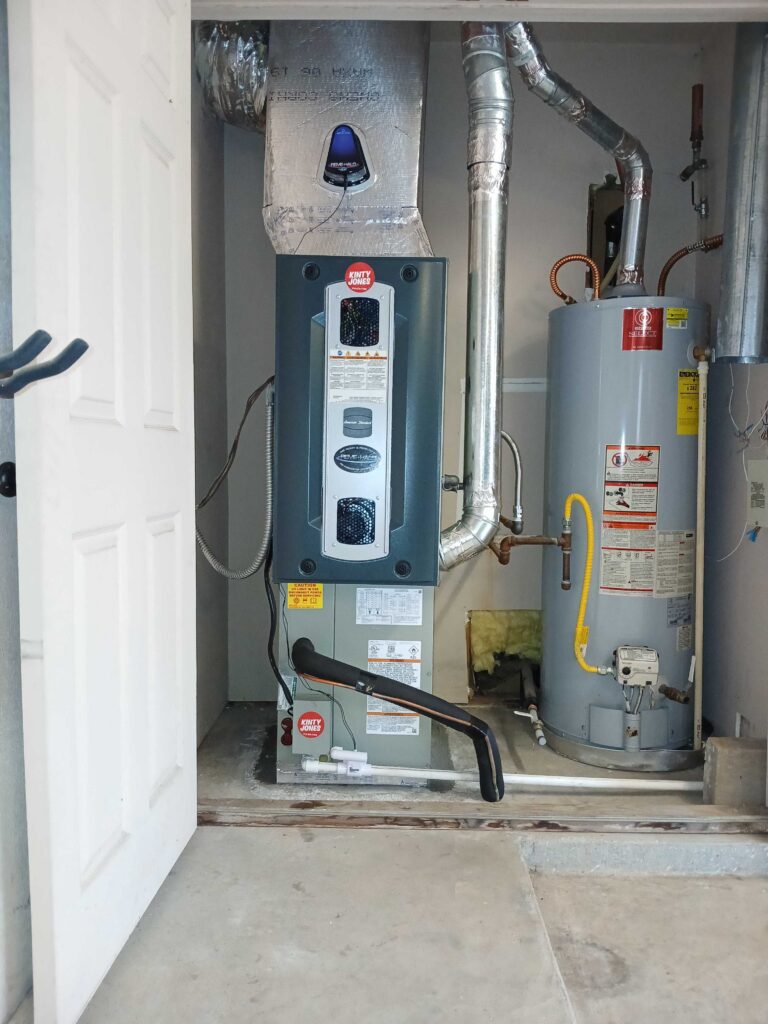
Check the dimensions printed on the existing filter and confirm the airflow arrow points toward the blower. If the slot has large gaps or no proper cover, professional correction may reduce bypass.
Replacement timing depends on filter type, household conditions, pets, construction dust, system runtime, and season. A three-month interval printed on a package is not a command to ignore a visibly dirty filter until day 90.
The article on clogged filters and airflow explains why loading increases system resistance. During heavy pollen periods, visual checks may need to happen more often even if replacement is not always necessary.
Higher resistance can reveal an airflow problem
A better filter should not leave rooms starved for air. If airflow falls sharply after an upgrade, the system may need a larger media area, a different filter rating, blower adjustment, return improvement, or correction elsewhere.
Do not assume the answer is always to return to the cheapest filter. The right response is to find out where the pressure problem occurs and choose a filtration setup the system can sustain.
Signs that airflow needs attention include:
- Weak supply air after changing filter type
- Whistling at the filter slot, returns, or doors
- A filter that bends or pulls inward
- Longer heating or cooling cycles with poorer comfort
- New coil icing or unusual equipment noise
Persistent low airflow in Fayetteville homes can involve returns, ducts, the blower, a dirty coil, or the filter setup. Measurement is more useful than blaming whichever component is easiest to see.
A variable-speed blower can provide flexible circulation, but it still operates within pressure and duct limitations. Controls cannot create an open airflow path where the system has a restriction.
Ducts and humidity affect the air you feel
Leaky return ducts can pull air from attics, crawlspaces, garages, or other unintended areas. Supply leaks can reduce delivery to the rooms and create pressure imbalances that draw more outdoor air through the building shell.
A professional ductwork inspection can look for disconnections, damaged flex duct, poor transitions, and return limitations. Cleaning is a separate decision and should respond to actual conditions rather than becoming an automatic allergy-season ritual.
Visible contamination, pest evidence, or significant debris may justify a closer look at ductwork cleaning services and source correction. Cleaning without fixing moisture, bypass, or damaged ducts may allow the same problem to return.
The same caution applies to air duct cleaning. It can address specific conditions, but it should not be sold as a universal cure for allergy symptoms.
Humidity matters because damp conditions can support indoor problems that filtration alone cannot solve. Fayetteville homeowners dealing with moisture discomfort may need broader indoor humidity solutions alongside particle filtration.
Whole-home humidity control should be based on measured conditions and the actual moisture source, not a guess from how the room feels.
A practical allergy-season routine for local homes
The most useful routine is simple enough to repeat. It combines seasonal system care with household steps that reduce what comes inside and keep air moving through the intended path.
Homeowners in both cities can adapt the same framework to their household. KJHC provides local HVAC services in Fayetteville for system-specific evaluation.
The same approach is available through KJHC’s HVAC services in Springdale. The filter recommendation should reflect the equipment in the home, not only the city on the address.
Prepare the system before peak pollen and cooling demand
Spring service is a useful time to check the filter cabinet, blower, indoor coil, condensate system, thermostat, and outdoor equipment before long cooling cycles begin. Fall service can revisit filtration and heating operation before windows close for colder weather.
A seasonal AC system inspection can reveal coil dirt, drainage trouble, weak electrical parts, and airflow restrictions. Those issues affect comfort and may interfere with the filtration plan.
Heating deserves the same attention because the central blower and filter may serve both systems. A heating tune-up in Fayetteville can confirm airflow and safe operation before regular winter use.
Springdale homeowners can use a seasonal furnace tune-up to address heating-side operation while reviewing the shared filter and blower path.
Homeowners who prefer recurring reminders can use the Kinty Club membership to structure inspections. Membership benefits do not change which filter the system can support, so compatibility still needs to be evaluated.
Build a routine around pollen, pets, and filter loading
Filter care works better as a quick recurring check than a date you remember twice a year. Mark the installation date on the frame and look at the media regularly during heavy-use and high-pollen periods.
Pair HVAC care with entry and cleaning habits. This reduces the amount of material the filter has to catch after it enters the home.
A practical routine looks like this:
- Check outdoor pollen conditions before opening windows for long periods.
- Leave shoes and outdoor gear near the entry when practical.
- Change clothes or shower after heavy outdoor exposure.
- Vacuum with suitable filtration and damp-dust settled surfaces.
- Check the HVAC filter monthly and replace it when loaded.
- Keep return grilles, supply vents, and the outdoor unit clear.
A preventive AC tune-up can complement that routine by addressing components homeowners should not service themselves.
Consistency matters more than turning the home into a laboratory. A handful of repeatable habits usually beats an elaborate plan that lasts until next Tuesday.
Call when comfort or airflow changes
Schedule professional evaluation if a filter upgrade causes weak airflow, unusual noise, icing, long cycles, or reduced comfort. Also call when moisture, odors, visible contamination, or recurring dust suggest a broader issue.
Do not keep stacking denser filters into the same slot in search of a higher number. A technician can measure static pressure, inspect the return path, and recommend a media configuration that balances filtration with airflow.
If rooms feel stale or the home lacks a clear fresh-air strategy, HVAC ventilation services may be part of the solution. Ventilation should be controlled and filtered appropriately rather than achieved through random leaks.
For allergy symptoms themselves, consult a qualified medical professional. HVAC filtration can reduce certain airborne triggers, but it should support, not replace, personal medical care.
Conclusion
Better HVAC filtration can help Fayetteville and Springdale homeowners reduce some airborne seasonal allergy triggers. The best setup uses a compatible filter, good fit, adequate airflow, reasonable runtime, and household habits that limit what enters the home.
MERV is useful for comparing particle capture, but the highest number is not automatically the best choice for every system. Filter depth, blower capability, ducts, loading, and replacement habits all affect real performance.
Think of filtration as one strong player on the indoor-air team. It works best alongside source reduction, system maintenance, moisture control, and medical guidance when symptoms require it.
For a filtration and airflow evaluation tailored to your Fayetteville or Springdale home, request service from KJHC.